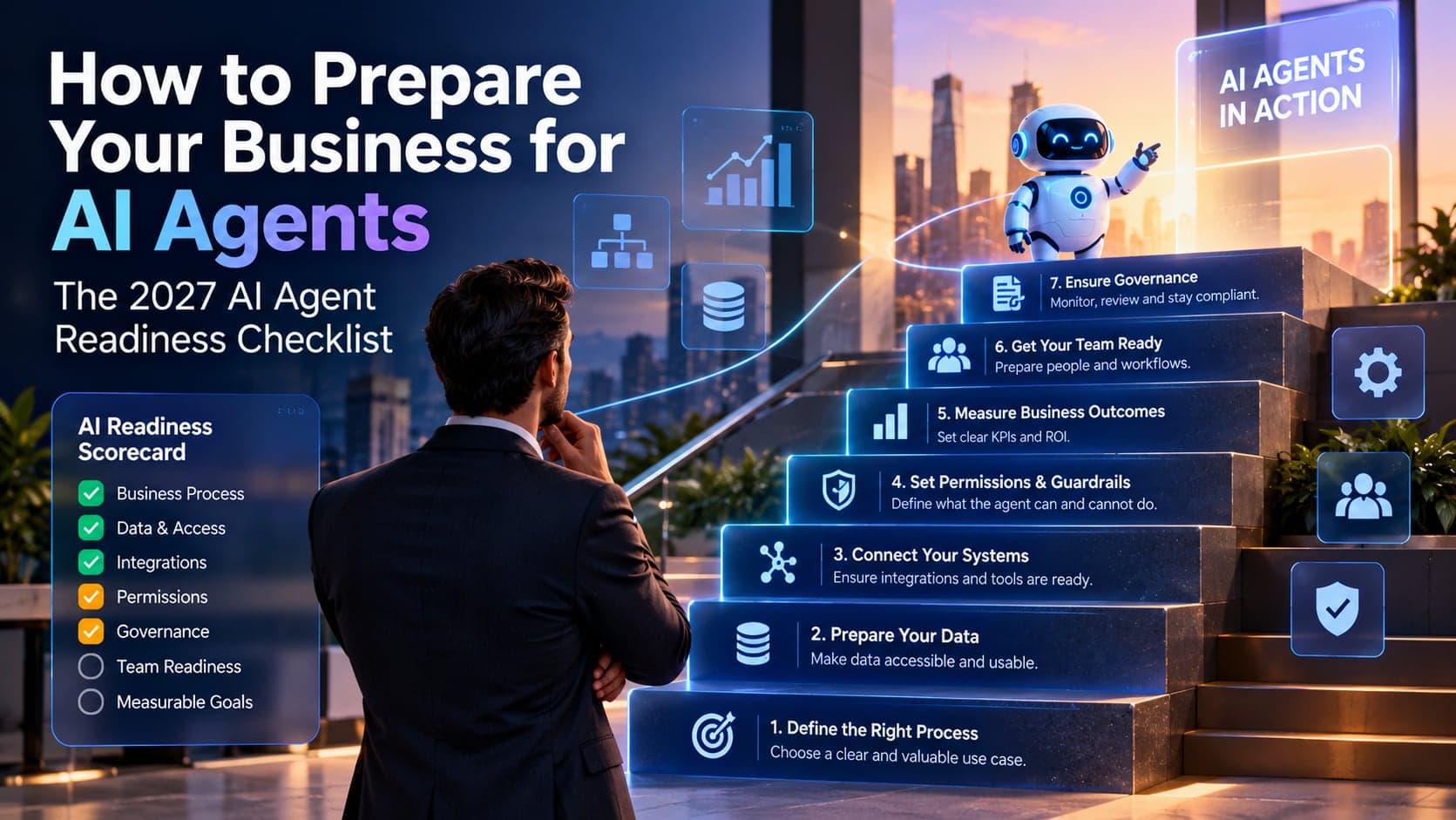
How to Prepare Your Business for AI Agents: The 2027 AI Agent Readiness Checklist
Is your business ready for AI agents? Use this 2027 checklist to assess workflows, data, integrations, permissions, governance, and ROI.
AI agents are moving out of experiments and into real business workflows. They can interpret a request, use connected tools, and work through multiple steps toward a goal — opening up opportunities in sales, customer support, operations, finance, and internal knowledge management.
But deploying an AI agent isn't a matter of picking a model or buying a tool. An agent needs a clearly defined task, access to reliable information, the right integrations, firm boundaries on what it can do, and a way for people to review important decisions. So the most useful question isn't "What can an AI agent do?" — it's "Is our business ready to use one reliably, safely, and profitably?"
In short: a business is ready to pilot an AI agent when it has a specific, measurable use case; accessible and trustworthy data; working integrations; clear permissions; human oversight; and an owner accountable for the result. If those foundations are missing, improve the process — or start with conventional AI workflow automation first.
There's a real gap between ambition and readiness. In Deloitte's August 2026 readiness research, only 5% of surveyed organisations described their business processes as highly prepared for AI agents; and Deloitte's State of AI in the Enterprise 2026 (a survey of 3,235 leaders across 24 countries, fielded August–September 2025) found roughly one in five organisations has a mature governance model for autonomous agents. These are survey snapshots, not universal benchmarks — but they point to the same conclusion: readiness, not enthusiasm, is the bottleneck.
This guide is a practical readiness checklist for 2027 planning — a way to find the gaps before you commit to implementation, not a certification or a guarantee of success.
What Is AI Agent Readiness?
AI agent readiness is the degree to which a business has the workflows, data, systems, permissions, governance, skills, and measurable objectives needed to deploy AI agents reliably.
Readiness isn't all-or-nothing. A company may be ready to pilot an agent for internal research but not ready to let one make customer-facing changes or move money. The right starting point depends on task complexity, potential impact, and acceptable risk. Assess one process at a time — not whether the whole company is "AI-ready" in the abstract.
The 7 Signs Your Business Is Ready for AI Agents
1. You Have a Clearly Defined Business Process
Start with a process, not a technology. "We want to use AI" isn't a business requirement. A good starting point is a recurring process with a clear beginning, a desired outcome, and known points where work slows down — researching and qualifying leads, answering internal policy questions, summarising customer cases, preparing account briefings, or gathering information for operations teams. (If you're still mapping opportunities, our guide to the business processes you can automate with AI is a useful starting point.)
Ask yourself:
- Can we describe the process from trigger to outcome?
- Do we know who owns the process and who uses its output?
- Can we separate steps that need judgment from steps that follow fixed rules?
- Can we define what a successful result looks like?
Example: Instead of "automate sales," define a process where an agent researches inbound leads, checks approved sources, summarises fit against agreed criteria, and prepares a briefing for a sales rep.
2. Your Business Has Accessible, Trustworthy Data
An agent is only as useful as the information it can access and interpret. Relevant data may live in a CRM, help centre, shared drive, product catalogue, ticketing platform, database, or policy library. The challenge isn't just whether the data exists — it's whether the agent can reach the right version, understand it, and respect permissions.
- Are important documents and records current, consistent, and findable?
- Are there clear owners for critical knowledge sources?
- Can the agent retrieve only the data it's authorised to use?
- Are sensitive, outdated, duplicated, or contradictory records identified?
- Can outputs be checked against source records when accuracy matters?
A tightly scoped pilot can work with a small, curated knowledge base. Fragmented or poorly governed data, on the other hand, limits reliability and makes scaling harder.
3. Your Systems Can Be Connected Reliably
Most agents need to work with existing software: reading a CRM record, searching a knowledge base, creating a ticket, drafting an email, or routing a task to a person. Integration is more than connecting APIs — it has to handle authentication, permissions, errors, rate limits, retries, duplicate actions, and changes in the connected apps.
- Can the required systems be accessed through supported APIs or controlled interfaces?
- Are service accounts and credentials managed securely?
- What happens if an integration fails or returns incomplete information?
- Can actions be logged and, where appropriate, reversed?
- Are system owners available to approve and maintain integrations?
If an agent can't reliably read what it needs or safely perform its assigned action, close that integration gap before increasing autonomy.
4. You Can Define What the Agent Is Allowed to Do
An agent should have explicit boundaries. It might be allowed to search approved information and draft a recommendation — but not send an external message, change a customer record, issue a refund, or approve a payment without permission. Controls should reflect the consequences of each action.
- Which data can the agent read?
- Which records or systems can it change?
- Which actions are prohibited?
- Which actions require human approval?
- How should it respond when information conflicts or it hits a permission boundary?
Use least-privilege access: give the agent only the permissions its task needs. Define escalation paths and test failure scenarios before production.
5. You Have a Measurable Business Outcome
A pilot needs a baseline and a success measure — otherwise it's hard to tell whether the agent is improving the process or just adding another layer of software. Useful metrics include time to qualify a lead, time to resolve a support case, correct routing rate, manual handling time, rework rate, or the share of outputs a human reviewer accepts.
Examples of measurable pilot goals:
- Reduce average lead-research time while maintaining qualification quality.
- Reduce time spent searching internal documentation while tracking answer accuracy.
- Improve ticket categorisation while monitoring misrouting and escalation rates.
- Reduce manual document handling while measuring extraction errors and correction time.
Set targets after measuring the existing process and weighing risk. Avoid generic ROI claims as if they apply to every business — outcomes vary with workflow design, data quality, integration complexity, usage, and oversight.
6. Your Team Is Ready for AI-Assisted Work
AI agents change how work gets done. People may need to review outputs, handle exceptions, improve source knowledge, or step in when the system reaches a boundary. Adoption can stall even when the technology works, if teams don't understand the new process.
- Who will use the agent, and who owns the process?
- Do employees know what the agent can and can't do?
- Is there a clear route to correct errors and report unexpected behaviour?
- Have training and change-management needs been considered?
- Will staff have time to validate outputs during the pilot?
Treat employees as part of the operating model. Be explicit about how responsibility is shared between the agent and the people who supervise, approve, or act on its work.
7. You Have Governance, Monitoring, and Oversight
Governance is a practical requirement, not paperwork to bolt on after launch. As systems gain the ability to take actions, you need to know what an agent is allowed to do, what it actually did, which information it used, and how to step in when something goes wrong. Minimum controls to consider:
- Named business and technical owners.
- Documented permissions, prohibited actions, and approval thresholds.
- Logs of tool calls and material actions, with suitable privacy controls.
- Evaluation tests for common cases, edge cases, and adversarial inputs.
- Monitoring for errors, unexpected behaviour, cost, latency, and failure rates.
- A human escalation route and a way to disable or roll back the workflow.
- Security, privacy, legal, and compliance review appropriate to the use case.
Controls should be proportional to impact: an internal research assistant and an agent that changes customer entitlements shouldn't share the same permissions or release process.
The AI Agent Readiness Scorecard
Use this scorecard to structure an initial discussion. It's a planning aid — a practical heuristic, not a validated scientific benchmark. Score each area 0, 1, or 2.
| Area | 0 — Not ready | 1 — Partially ready | 2 — Ready |
|---|---|---|---|
| Process | Problem unclear | Mapped with gaps | Owner, trigger, process, outcome defined |
| Data | Unavailable or unreliable | Some sources usable | Current, relevant, permissioned sources |
| Integrations | Required systems inaccessible | Some integrations; gaps remain | Required actions tested with error handling |
| Permissions | No action boundaries | Boundaries identified, not tested | Least privilege and approvals defined |
| Governance | No owner or monitoring | Some controls incomplete | Owners, logs, monitoring, rollback planned |
| People | No users or operating model | Users identified; gaps remain | Training and review roles clear |
| KPIs | No baseline or target | Metrics identified | Baseline, target, guardrails, review cadence |
A rough way to read the total (a heuristic, not a universal standard): 0–4 — strengthen foundations and consider conventional automation; 5–9 — close the major gaps and assess a tightly scoped, supervised pilot; 10–14 — consider a controlled pilot or production expansion, provided your risk, security, and compliance reviews also pass.
And don't let a high total paper over a critical gap: a strong score doesn't make up for missing permission controls when an agent can change financial or customer records.
Which Business Processes Should You Consider First?
A good first use case is usually narrow, measurable, valuable, and safe to supervise. These are starting points — not recommendations to automate without analysing the process first.
| Function | Possible agent-assisted workflow | Human control to consider |
|---|---|---|
| Sales | Research a lead, summarise approved sources, compare with criteria, prepare a briefing | Human validates fit and approves outreach or CRM changes |
| Customer support | Retrieve knowledge, classify request, draft answer, prepare escalation context | Review sensitive, ambiguous, or high-impact cases |
| Operations | Gather cross-system information, identify exceptions, recommend next steps | Approval before irreversible or high-impact actions |
| Finance | Extract and classify document data, flag discrepancies, prepare review package | Human approval for payments or accounting exceptions |
| HR / knowledge | Find approved policy information, summarise guidance, route unresolved questions | Escalate personal, legal, or sensitive employment matters |
| Marketing | Research a topic, assemble a brief, draft content, check workflow fields | Editorial review and approval before publishing |
What Should Not Become an AI Agent?
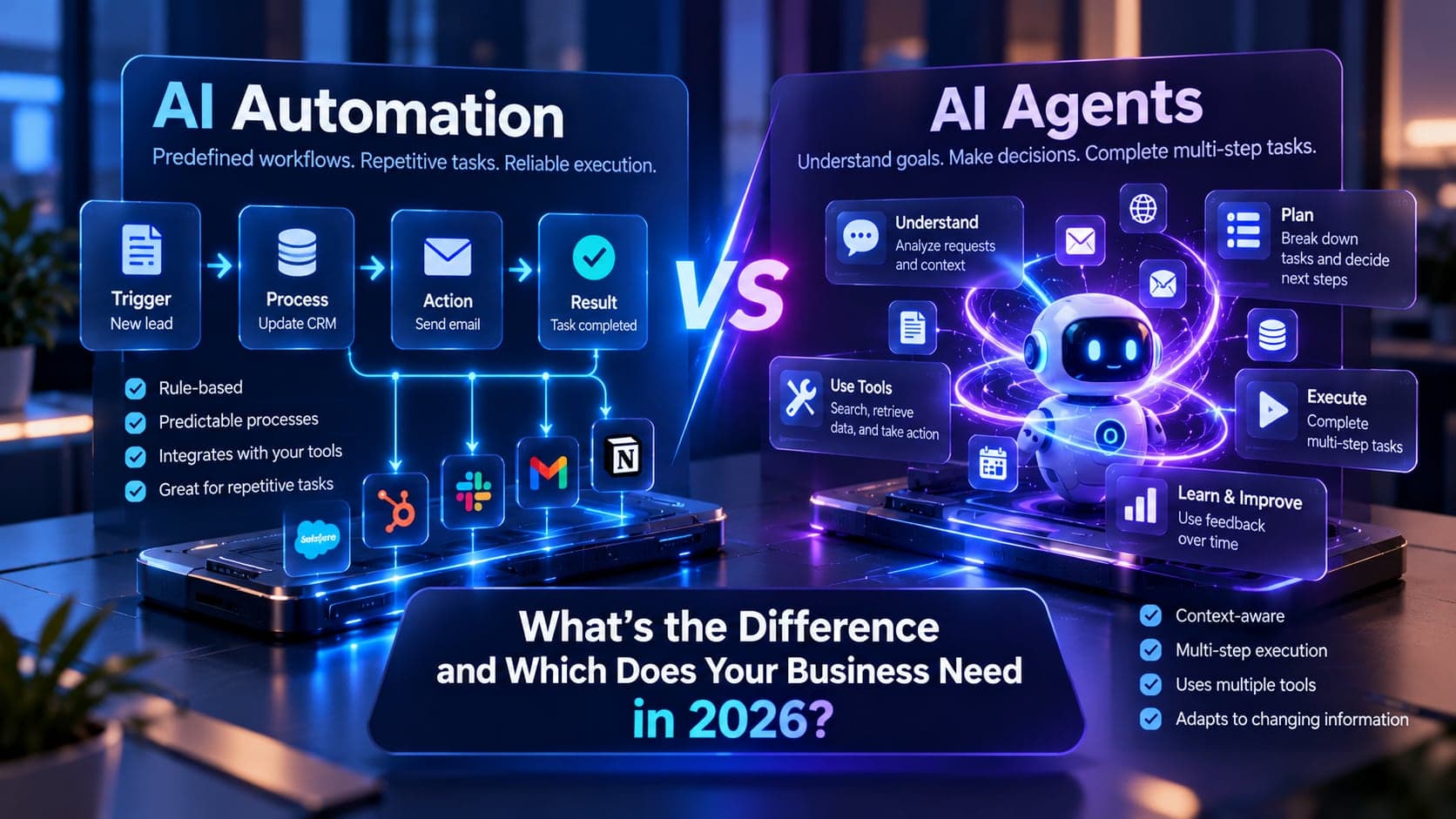
Not every workflow needs an agent. If a task has predictable inputs, fixed rules, and a known sequence, conventional workflow automation is usually easier to test, explain, and maintain:
- Simple notifications triggered by a known event.
- Fixed data transfers between systems.
- Predictable CRM field updates based on explicit rules.
- Scheduled reports with stable definitions.
- Basic approval routing where the decision logic is already clear.
The goal isn't maximum autonomy. It's the simplest architecture that reliably achieves the business outcome.
AI Agent vs AI Automation vs Hybrid: A Practical Rule
| If the process is… | Consider… | Why |
|---|---|---|
| Repetitive, predictable, rule-driven | Workflow automation | Steps can be defined and tested in advance. |
| Contextual, unstructured, multi-step | AI agent with clear boundaries | Next steps may depend on information gathered during the task. |
| A mix of fixed steps and variable judgment | Hybrid approach | An agent interprets or recommends while deterministic workflows execute controlled actions. |
For a deeper comparison, see our guide on AI agents vs AI automation, which breaks down how each works and when to use them.
How to Start Your First AI Agent Project
- Choose one workflow. Pick a bounded process with a clear owner and a meaningful pain point.
- Define the business outcome. Record the baseline, target, quality requirements, and unacceptable failure modes.
- Map data and systems. Identify information sources, integrations, permissions, and dependencies.
- Set boundaries and oversight. Specify allowed actions, approval requirements, and escalation triggers.
- Pilot, evaluate, and scale carefully. Test normal and edge cases, measure performance, review incidents, and expand only when the evidence supports it.
Give the pilot a stop condition as well as a success condition: if accuracy, cost, latency, or exception rates fall outside agreed limits, pause and revise the design. Many of these first use cases are a natural fit for AI agents for business processes.
What Affects AI Agent Implementation Cost?
There's no single reliable price for an AI agent. Cost depends on the process and your production requirements — not just the model or software licence. The main drivers:
- Workflow complexity: number of steps, decision points, exceptions, and rules.
- Integration scope: number and maturity of connected systems, APIs, and authentication patterns.
- Data preparation: cleaning, permissions, retrieval, and source maintenance.
- Security and governance: access controls, audit trails, privacy reviews, approval flows.
- Testing and evaluation: test cases, quality measures, monitoring, regression testing.
- Human oversight: review queues, escalation paths, exception handling.
- Ongoing operation: model usage, infrastructure, support, monitoring, maintenance.
Ask providers to separate discovery, implementation, integration, evaluation, and ongoing support — and to spell out what's included, which assumptions drive the estimate, and how performance will be measured.
How to Choose an AI Implementation Partner
A good partner understands the business process as well as the technology. Ask how they'll validate the use case, protect data, manage permissions, test failure modes, integrate with existing systems, and support the solution after launch. Look for:
- Relevant experience with similar workflows and systems.
- A clear discovery and process-mapping method.
- An evaluation plan with measurable acceptance criteria.
- Security, privacy, permissions, and governance expertise fit for your use case.
- Transparent scope, assumptions, ownership, maintenance, and support.
- A willingness to recommend ordinary automation when an agent isn't needed.
For a practical evaluation framework, see our guide on how to choose the right AI automation agency.
How AI Partners Hub Can Help
Once you know the process, systems, data constraints, risk level, and intended outcome, you can compare providers against those requirements — instead of choosing on hype. AI Partners Hub helps businesses discover AI solution providers and identify expertise that matches their needs, whether that's workflow automation, AI agents, a chatbot, voice AI, or a custom AI solution. Start with the business outcome and the capabilities required to deliver it.
Frequently Asked Questions
What is AI agent readiness?
AI agent readiness is how prepared a business is to deploy an AI agent reliably. It includes a defined process, accessible and trustworthy data, working integrations, clear permissions, human oversight, governance, and measurable success criteria.
How do I know if my business is ready for AI agents?
Start with one clearly defined process. Check whether the required data is accessible, systems can be connected safely, permissions are explicit, a person owns the outcome, and success can be measured. Address critical gaps before increasing autonomy.
What data does an AI agent need?
It depends on the task. An agent may need approved documents, CRM records, product information, support tickets, or other business sources. The data should be relevant, current, permissioned, and retrievable — more data isn't automatically better.
What governance is needed before deploying AI agents?
Define ownership, allowed and prohibited actions, access controls, human-approval thresholds, logging, evaluation, monitoring, escalation, and a way to pause or roll back the workflow. Controls should reflect the impact and risk of the agent's actions.
Which business processes are best for AI agents?
Good candidates usually involve contextual information and multiple steps — lead research, internal knowledge retrieval, support-case summarisation, or operations triage. The best candidate is bounded, measurable, and safe to supervise.
Should my business use AI agents or workflow automation?
Use workflow automation for predictable, rule-based processes; consider an agent when a task requires context-aware decisions across multiple steps; consider a hybrid approach when both judgment and fixed execution matter.
How much does AI agent implementation cost?
Cost depends on workflow complexity, integrations, data preparation, model usage, security, testing, monitoring, oversight, and maintenance. Ask providers to separate discovery, build, integration, evaluation, and support costs.
How do I start an AI agent pilot?
Choose one workflow, define an outcome and baseline, map data and systems, set permissions and human-review rules, and test normal and edge cases. Expand only when performance, cost, and risk stay within agreed limits.
Final Thoughts: Readiness Before Autonomy
AI agents can create real value when they're applied to the right process and backed by reliable data, well-designed integrations, clear permissions, capable teams, and appropriate governance. They aren't automatically better than conventional automation, and no checklist can replace testing in the real operating environment.
Start with a specific problem, measure the current process, close the most important gaps, and run a controlled pilot. Expand only when the evidence shows the agent is reliable, useful, and safe enough for the next level of responsibility.
Key takeaway: your business doesn't need to be ready for every possible AI agent. It needs to be ready for one well-chosen workflow, with clear boundaries and a measurable outcome.
Not sure whether your business needs AI automation, an AI agent, or both? Find the right AI partner — free for businesses — or explore the directory and compare expertise that matches your workflows, systems, data, and goals. Run an AI agency? List your agency and get discovered when businesses are planning their first agent project.