AI Agents vs AI Automation: What's the Difference and Which Does Your Business Need in 2026?
AI agents vs AI automation explained. Compare how they work, when to use each, costs, risks, and whether your business needs one or both.
"AI agents" and "AI automation" get used as if they mean the same thing. They don't. Both reduce manual work and improve how a business runs — but they solve different kinds of problems, and reaching for the wrong one adds cost and complexity you don't need.
This guide explains what AI automation is, what an AI agent is, how they differ, when to use each, when to combine them, what drives implementation cost, and how to decide what's right for your business in 2026.
The short version: not every process needs an autonomous agent. Some workflows are better handled by reliable AI workflow automation solutions, while more complex, multi-step tasks may benefit from AI agents for business processes that can interpret context, use tools, and act within defined limits.
AI Agents vs AI Automation: The Short Answer
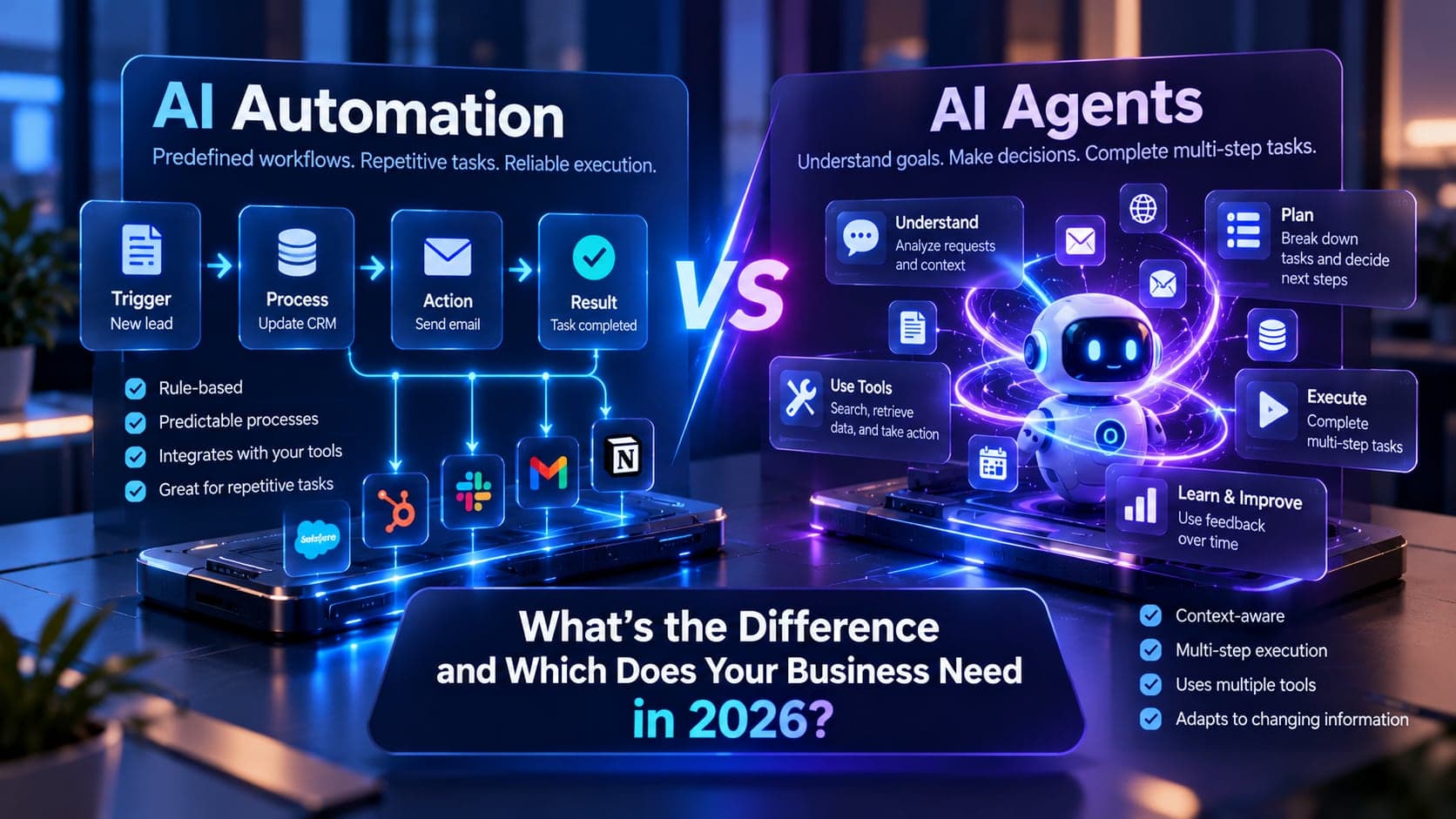
AI automation typically follows predefined workflows, rules, triggers, and integrations to perform predictable tasks. AI agents can interpret a goal or context, use tools, make decisions within defined boundaries, and complete multi-step tasks. The best choice depends on the process: predictable workflows usually suit automation, while contextual, multi-step work may benefit from agents — and many businesses use a combination of both.
What Is AI Automation?
AI automation combines AI capabilities with workflows, business rules, and software integrations. It's especially useful when a process has clear inputs, predictable steps, and measurable outcomes.
For example, a lead form can trigger a workflow that creates a CRM record, assigns the lead to a salesperson, and sends a notification. AI is added where interpretation helps — classifying the lead's intent, say, or summarising the enquiry.
The defining characteristic is control: the workflow is designed in advance, and the system executes known steps.
What Is an AI Agent?
An AI agent is a system designed to pursue a goal — by interpreting information, deciding what actions to take within its permissions, using tools or connected systems, and progressing through multiple steps. The level of autonomy varies widely by implementation.
For example, an AI sales agent might review an inbound enquiry, research relevant information from approved sources, decide whether the lead meets defined criteria, update the CRM, prepare a briefing, and suggest the next action for a salesperson.
The important distinction isn't simply that an agent uses AI. It's that the system can work through a task or process, rather than only generating a single response.
AI Agents vs AI Automation: Key Differences
Here's how the two compare across the dimensions that matter when you're choosing an approach:
| Dimension | AI Automation | AI Agents |
|---|---|---|
| Workflow | Predefined workflow and rules | Can plan or adapt across multiple steps |
| Decision-making | Mostly rule-based; AI may classify or generate | Context-aware decisions within defined boundaries |
| Inputs | Often structured or predictable | Structured + unstructured information |
| Autonomy | Usually low to medium | Medium to high, depending on controls |
| Best for | Repeatable processes | Complex, contextual, multi-step tasks |
| Oversight | Often straightforward to validate | Explicit permissions, monitoring and escalation |
| Complexity | Usually lower | Usually higher |
The difference isn't absolute. Modern business systems increasingly combine deterministic automation with agentic capabilities.
Real Business Examples
The same process can be handled by automation, by an agent, or by both working together:
| Process | Automation approach | Agent approach |
|---|---|---|
| Customer support | Ticket → category → team | Understand request → retrieve approved information → check account/order context → respond or draft → escalate exceptions |
| Sales | Form → CRM → salesperson | Understand requirements → research approved sources → qualify → update CRM → prepare briefing → suggest next action |
| E-commerce | Order event → tracking lookup → status email | Understand complaint → check order/policy → determine resolution → prepare response → escalate exceptions |
| Internal knowledge | Scheduled content sync | Understand question → retrieve authorised sources → synthesise answer → provide source references |
When Should You Use AI Automation?
AI automation is usually the right starting point when:
- The process is repetitive.
- Rules and exceptions are reasonably clear.
- Inputs and outputs are predictable.
- The workflow connects known systems.
- The result is easy to validate and measure.
Typical examples include lead routing, notifications, data synchronisation, document extraction with validation, recurring reporting, standard approvals, and customer-support triage — the bread and butter of AI workflow automation.
When Should You Use an AI Agent?
An AI agent is worth considering when:
- The task requires interpreting natural language or unstructured information.
- The work involves several steps or systems.
- The next action depends on context.
- The process can't be represented effectively with fixed rules.
- There's a measurable goal and a clear boundary for what the agent may do.
Typical examples include research, complex customer-service resolution, lead qualification, internal knowledge work, and multi-step operational tasks. Before giving an AI agent significant autonomy, define its permissions, escalation paths, and human-review points.
Should You Use AI Agents and Automation Together?
Often, yes. A hybrid architecture uses an AI agent for interpretation, planning, or decision support, and deterministic automation for predefined actions.
For example, an agent can interpret an incoming customer request and decide whether it's a billing issue, a delivery issue, or a technical problem. A workflow then executes the known routing, CRM update, notification, and ticket actions.
This gives you flexibility without handing an AI system unnecessary control over every operational step.
AI Agents Are Not Always the Better Choice
If a process can be handled reliably by a simple workflow, adding an autonomous agent can introduce unnecessary complexity. Agents tend to require more monitoring, testing, permissions, governance, and maintenance.
The goal isn't maximum autonomy. It's the right level of automation for the business problem in front of you.
How Much Does an AI Agent Cost?
There's no universal price for an AI agent. Implementation cost depends on what the agent needs to do and how safely it has to operate. The main cost drivers are:
- Workflow complexity and number of steps
- Number and type of integrations
- Model and API usage
- Data preparation and knowledge sources
- Security and access controls
- Monitoring, evaluation and testing
- Human approval and escalation requirements
- Ongoing maintenance and support
Because of this, compare the total implementation and operating requirements — not just an initial development quote.
How to Choose the Right AI Approach
A simple decision framework:
- Is the process repetitive and predictable? If yes, start by evaluating AI automation.
- Does it require contextual, multi-step decisions? If yes, evaluate an AI agent.
- Does it contain both predictable and contextual steps? Consider a hybrid agent + automation architecture.
- Is the business impact measurable? If yes, it's a stronger candidate for a pilot.
Before implementation, define success metrics, permissions, human-review points, failure handling, data access, and ownership. If you're weighing whether to build in-house or bring in a partner, our guide on how to choose the right AI automation agency walks through the criteria.
AI Agents, Automation, and the Future of Business Workflows
The market is clearly moving toward more capable, multi-step AI systems — but the practical opportunity isn't to replace every workflow with an agent. Businesses are moving toward combinations of AI, automation, software integrations, and human oversight.
Recent 2026 industry research points the same way: Deloitte's State of AI in the Enterprise reports that agentic AI usage is expected to rise while governance maturity lags; Anthropic's 2026 State of AI Agents report finds that 57% of surveyed organisations use agents for multi-step workflows; and Google Cloud describes agentic workflows as a major business trend for 2026. These are different research programs and shouldn't be treated as directly comparable measurements.
The practical lesson is simple: choose the architecture that fits the process, not the technology that sounds most advanced.
How AI Partners Hub Can Help
Choosing between automation, AI agents, or a hybrid approach usually takes implementation expertise. The right partner understands your workflow, existing systems, data, security requirements, governance needs, and the business outcome you're after.
AI Partners Hub helps businesses explore AI solution providers and find expertise aligned with their automation, AI agent, chatbot, voice AI, and custom-AI requirements.
Frequently Asked Questions
What is the difference between AI agents and AI automation?
AI automation typically follows defined workflows, rules, triggers, and integrations to complete predictable tasks. AI agents can interpret goals or context, use tools, make decisions within defined boundaries, and complete multi-step tasks. Many businesses use both together.
Are AI agents better than workflow automation?
Not necessarily. If a process is repetitive, predictable, and rule-based, workflow automation may be simpler, more reliable, and easier to govern. AI agents are more useful when a task requires interpretation, contextual decisions, or multiple steps across systems.
When should a business use an AI agent?
Consider an AI agent when the task involves unstructured information, contextual reasoning, multiple steps, tool use, or decisions that can't be represented well by fixed rules. Define permissions, escalation paths, and human review before giving an agent significant autonomy.
When should a business use workflow automation?
Use workflow automation when inputs, rules, and outcomes are relatively predictable — routing leads, triggering notifications, moving records between systems, and running standard approval workflows.
Can AI agents and automation work together?
Yes. A common architecture uses an AI agent for interpretation or decision-making and deterministic automation for predefined actions. This hybrid approach balances flexibility with control.
How much does an AI agent cost?
There's no single standard price. Cost depends on workflow complexity, integrations, data requirements, model and API usage, security, monitoring, human review, and ongoing maintenance.
How do I choose an AI automation agency?
Define the business process, systems, data, security requirements, desired outcomes, and human-approval points. Then compare providers on relevant experience, technical approach, integration capability, governance, support, documentation, and comparable work. You can browse specialists on AI Partners Hub or get matched for free.
What business processes are best for AI agents?
AI agents can be useful for research, customer-service resolution, lead qualification, internal knowledge work, multi-step operations, and workflows that need information from several systems. Good candidates have clear goals, measurable outcomes, appropriate data access, and defined limits.
Final Thoughts: Not Sure Whether You Need AI Automation, AI Agents, or Both?
AI automation and AI agents aren't competing technologies — they're different approaches to improving business processes. Automation is often the better choice for predictable workflows. Agents can be valuable when tasks need interpretation, context, tools, and multiple steps. A hybrid approach can combine the strengths of both.
Start with a clearly defined business problem, test a focused workflow, measure the result, and expand only when the evidence supports it.
Find the right AI partner — free for businesses — or explore the directory and compare expertise that matches your needs. Run an AI agency? List your agency and get discovered when businesses are deciding between automation and agents.